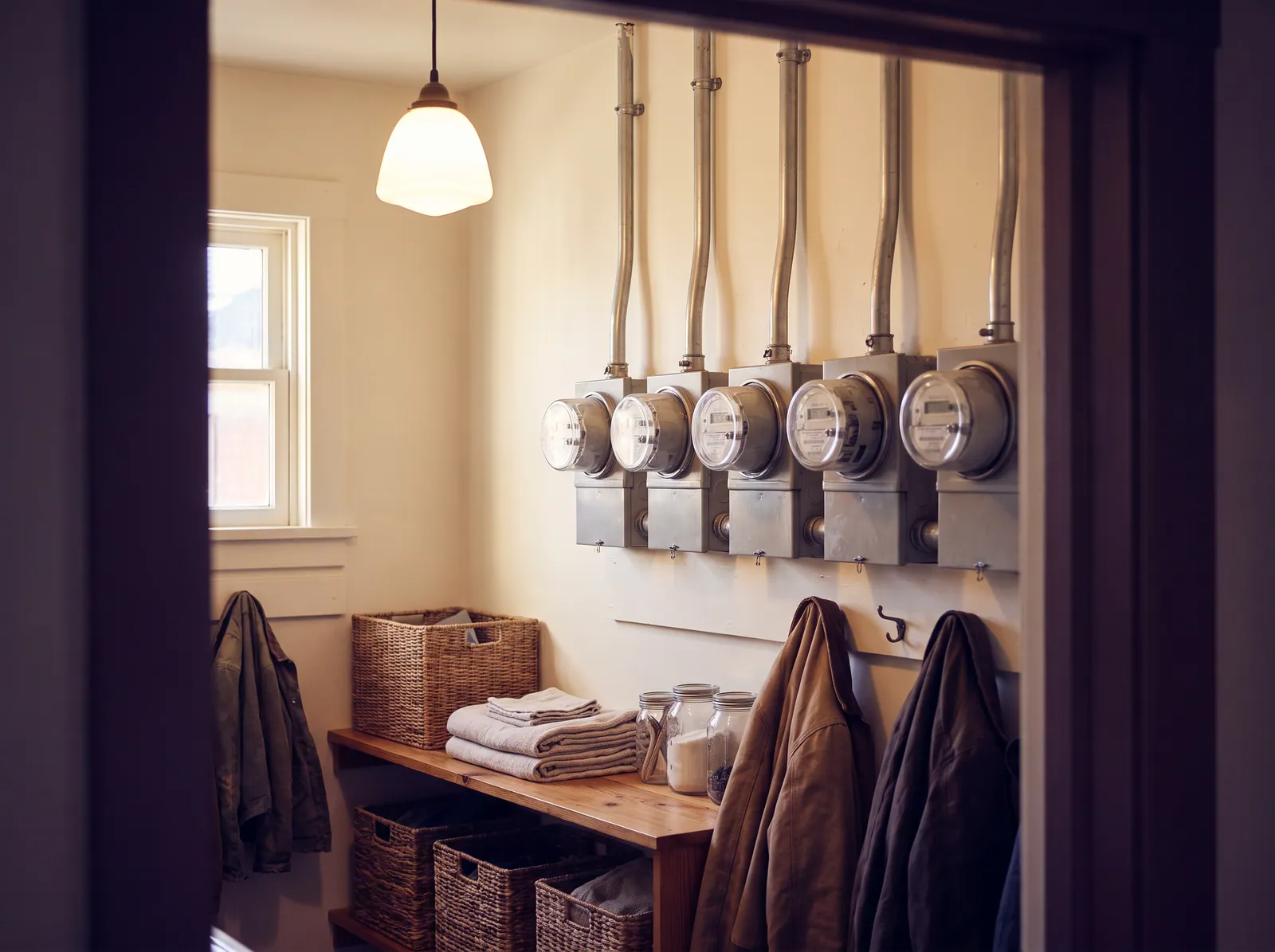

In a 2020 federal survey, about 113 million of 124 million US homes paid all their own energy bills.[1] In apartments, it depends on how the building is metered. That’s one of the less obvious parts of how energy works, and here’s how each setup works and how to tell which one you have.
What are the three ways an apartment can be metered?
Direct metered (individually metered)
Your unit has its own utility meter, and the utility bills you for what it records. The account is in your name, and you pay the utility directly. Hallways and parking lot lights often run on a separate meter in the owner’s name.
Master metered
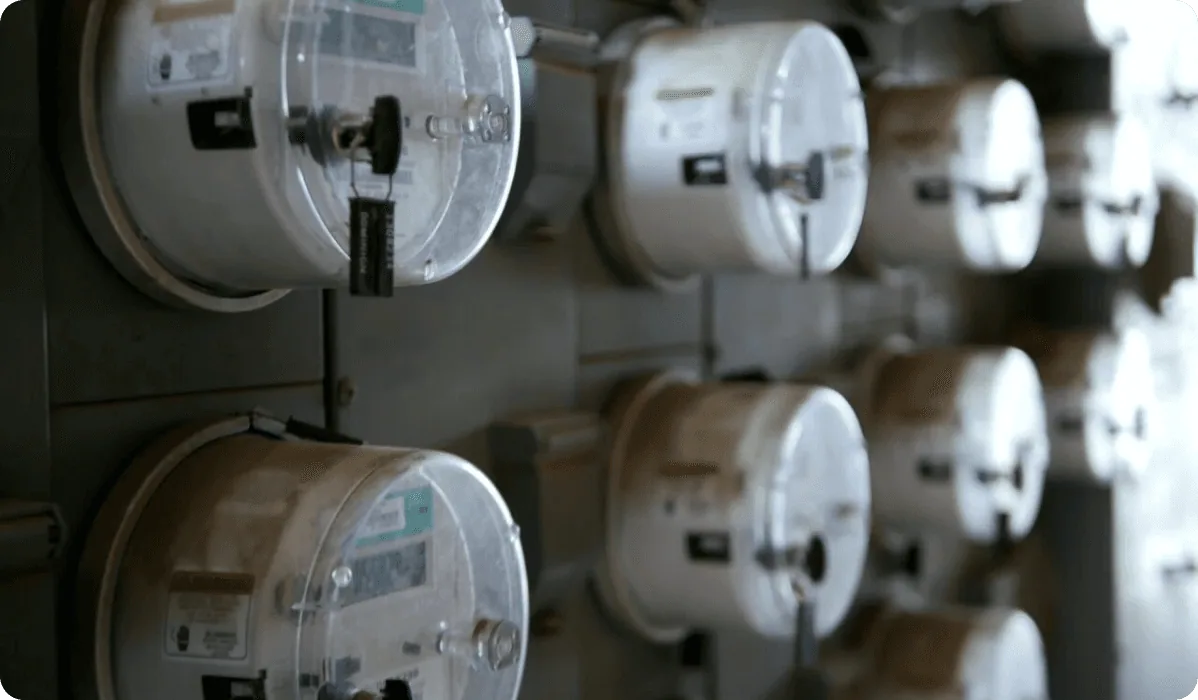
One utility meter measures the whole building, so the owner gets one bill and is the utility’s customer. The cost of that electricity then reaches residents in one of two ways.
- It’s included in your rent. You don’t get a separate electric bill, and your rent covers the cost.
- It’s billed back to each unit. The property bills you for your share, either from a submeter on your unit or with a formula called RUBS.
Submetered
The building still has one master meter, and the owner adds a smaller meter, called a submeter, to each unit. New York’s utility regulator describes submetering as a way for property owners to “sell electricity service to occupants.”[3] You pay for what your submeter records, on a bill from the property or a billing company.
That means every submetered building is master-metered, but not every master-metered building is submetered.
What’s the difference between RUBS and submetering?
Submetering measures your unit’s usage, and RUBS doesn’t. A submeter counts your kilowatt-hours (kWh), the unit electricity use is measured in, and your charge follows that count.
RUBS, short for ratio utility billing system, splits the building’s bill with a formula instead. The formula often uses your unit’s square footage or the number of people living there. Both arrive as a utility charge from the property, so they’re easy to mix up.
What it’s based on
- Submetered
- Your unit’s own meter
- RUBS
- A formula, like square feet or people
What the bill shows
- Submetered
- A meter reading or the kWh you used
- RUBS
- The building’s total and your share
A typical line
- Submetered
- Your usage: 512 kWh
- RUBS
- Your share: 4.2%
Does your own usage change it?
- Submetered
- Yes, directly
- RUBS
- Only as part of the building’s total
Direct, master or submetered: what’s the difference?
The biggest difference is who the utility’s customer is. When it’s you, the account, the bill and your usage data are in your name. When it’s the property owner, they sit with the building’s account instead.
Who is the utility’s customer?
- Direct metered
- You
- Submetered
- The property owner
- RUBS
- The property owner
- Included in rent
- The property owner
Who sends your bill?
- Direct metered
- The utility
- Submetered
- The property or a billing company
- RUBS
- The property or a billing company
- Included in rent
- No separate bill
What is your charge based on?
- Direct metered
- Your meter
- Submetered
- Your submeter
- RUBS
- A share of the building’s bill
- Included in rent
- Part of your rent
Where can you see your usage?
- Direct metered
- Your utility account
- Submetered
- Your bill from the property
- RUBS
- Not measured by unit
- Included in rent
- Not measured by unit
Can you choose a supplier or join community solar?
- Direct metered
- Where they’re offered
- Submetered
- Up to the account holder
- RUBS
- Up to the account holder
- Included in rent
- Up to the account holder
Can you connect it to Public Grid?
- Direct metered
- Yes
- Submetered
- No
- RUBS
- No
- Included in rent
- No
Supplier choice and community solar both work through a utility account. Where it’s offered, anyone with a utility account can choose the company that supplies their power.[4] In New Jersey, community solar works the same way: “one electric meter denotes one subscriber.”[5]
How do I know which setup my apartment has?
Your bill is the quickest clue, and your lease usually spells it out too. Look at who the bill comes from and whether it shows a meter reading for your unit.
Find your answer
Which setup do I have?
- “I get an electric bill from the utility, in my name.”
You’re direct-metered.
Your unit has its own utility meter, and you’re the utility’s customer. You can see your usage in your utility account and use programs like community solar where they’re offered. You can also connect your account to Public Grid.
- “The property or a billing company bills me, and the bill shows my meter reading or kWh.”
You’re submetered.
The building has one master meter, and a submeter on your unit measures what you use. You pay for that usage on a bill from the property or its billing company, so using less lowers your charge.
- “The property bills me a share of the building’s electricity, or a charge per person or per square foot.”
You’re on RUBS (ratio utility billing).
The building has one master meter, and your charge is a share of its bill, worked out by a formula. The formula usually looks at your unit’s size or how many people live there. Your lease or the billing company can tell you which one your building uses.
- “Electricity is included in my rent. I never see a bill.”
You’re master-metered, with utilities included.
The owner pays the building’s electric bill, and the cost is part of your rent. You won’t get a separate electric bill, and there’s no utility account in your name.
- “I’m not sure, or I haven’t moved in yet.”
Check the lease, the bill and the meters.
The utilities section of your lease usually says who pays for electricity. You can also look for a meter labeled with your unit number.[2] If you set up electricity yourself, you’re direct-metered, and our guide to setting up electricity in a new apartment walks you through it.
How does each setup show up on your bill?
If you’re direct-metered, you get a bill from the utility with your name, your account number and your meter’s kWh. Your usage drives both the supply charge (the electricity itself) and the delivery charge.
- Your kWh × the supply rate
- Your kWh × the delivery rate
If you’re submetered or on RUBS, the charge comes from the property or its billing company instead. The submetering vs. RUBS table above shows what each one looks like. If electricity is included in your rent, you won’t see a separate charge at all.
Does a smart meter change how you’re billed?
A smart meter doesn’t change your setup, because it’s the utility’s meter, not a billing method.
In 2022, US utilities had about 119 million smart meters, roughly 72% of all electric meters. They record your usage at least every hour and share it with you at least once a day.[6]
- Direct-metered: you can usually see hourly or daily use in your utility account, and many utilities let you download it with a “Green Button.”[7]
- Submetered: your usage comes from the property’s billing company, on your bill or its website.
- RUBS or included in rent: there’s no reading for your unit, because only the building is metered.
How Public Grid helps
If your unit is direct-metered, you can connect your utility account, and we’ll look for programs and rates that can lower your bill. If you’re moving somewhere you pay the utility, we can set up service at move-in. In a master-metered building, the account belongs to the property, so there’s nothing for you to connect.
Common questions
No. A submeter is a meter the property adds to your unit, behind the building’s master meter, and the property or its billing company reads it. A smart meter is a utility meter that records your usage at least every hour. A submeter can be read remotely too, but it isn’t the utility’s meter.
Sources · 7
- 12020 Residential Energy Consumption Survey, Table CE2.1: Annual household site fuel consumption (payment method for energy bills) · U.S. Energy Information Administration
- 2Locating Your Meter · FirstEnergy
- 3Electric Submetering Information · New York State Department of Public Service
- 4Can customers choose their electricity supplier? · U.S. Energy Information Administration
- 5Community Solar FAQs: Subscribers (New Jersey) · JCP&L (FirstEnergy)
Show all 7Show fewer
- 6How many smart meters are installed in the United States, and who has them? · U.S. Energy Information Administration
- 7Green Button · U.S. Department of Energy
