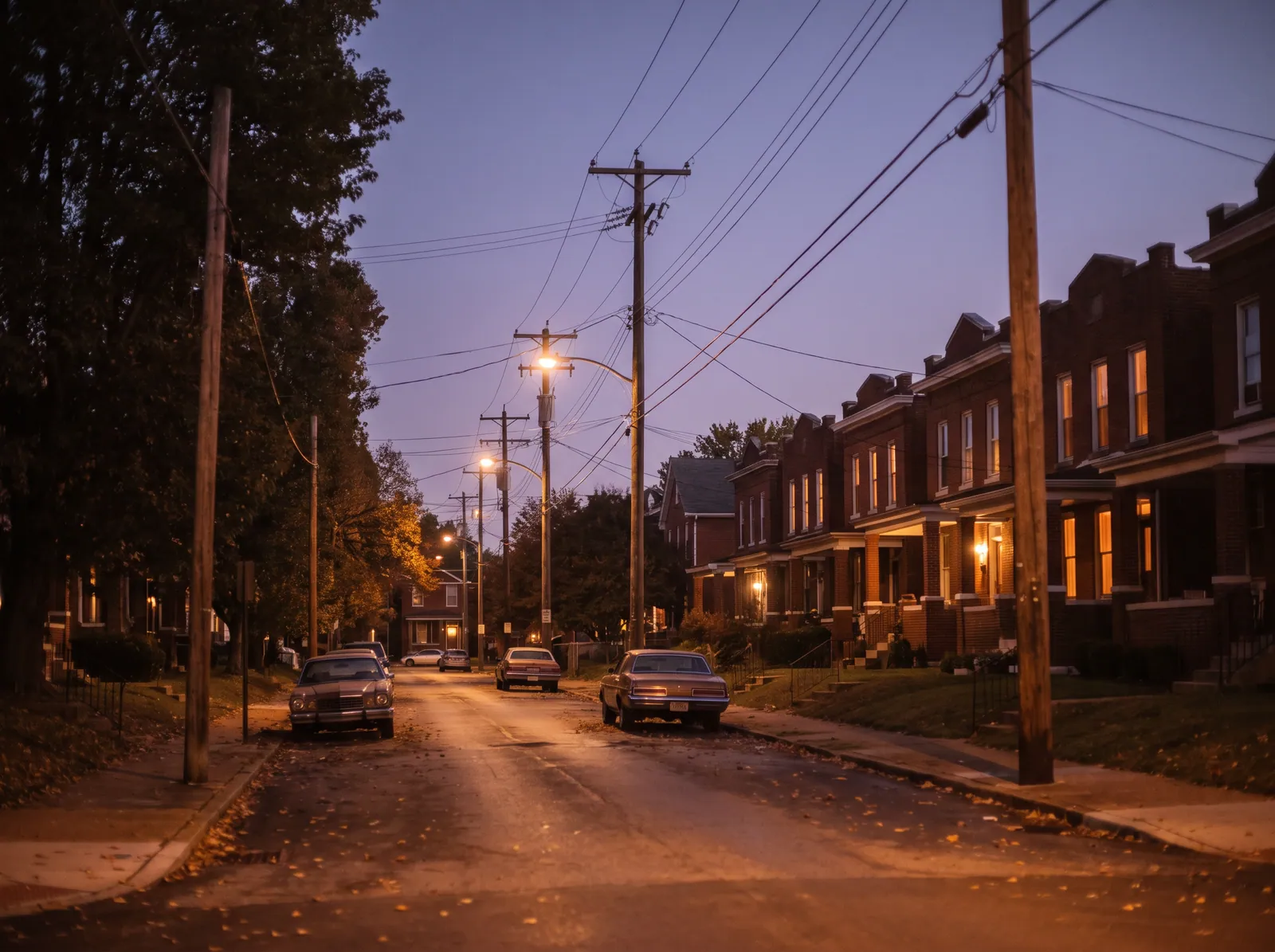

Behind every light switch is a power plant that may be hundreds of miles away. The National Academy of Engineering named electrification the top engineering achievement of the 20th century.[22]
This guide follows your power from the plant to your outlet, and shows where each step lands on your bill. For more, see our guides to how energy works.
How does the power grid work?
The power grid is a network of power plants, wires and control rooms that makes electricity and delivers it the moment you need it. It’s easier to picture as a restaurant, so here are its five main parts, each with a real number.
Power plants are the kitchens
Every kitchen cooks the same dish, electricity, from different ingredients: gas, wind, sun, water, coal or uranium.In real life
US utility-scale plants generated about 4.43 trillion kilowatt-hours (kWh), the unit your usage is measured in, in 2025.[1]
Wires are the roads
Transmission lines are the interstates, and they carry a lot of power a long way. Distribution lines are the local streets that end at your driveway.In real life
The US has thousands of miles of high-voltage lines and millions of miles of low-voltage lines.[2]
Grid operators are air traffic control
They don’t make the power, and they don’t own most of the roads. They watch everything that’s moving and keep it from colliding.In real life
A balancing authority “ensures, in real time, that power system demand and supply are finely balanced.”[6]
Batteries are the pantry
Grid batteries store extra power when there’s plenty of it, like at midday when the sun is strong, and hand it back later.In real life
Developers plan to add 24 gigawatts of utility-scale battery storage in 2026.[17]
Your home is the dinner table
This is where everything ends up. The meter by your door counts every bit that’s served.In real life
The average US home used about 899 kWh a month in 2022.[21]
Where does US electricity come from?
Most US electricity comes from natural gas, followed by renewables, nuclear and coal. Here’s how the US Energy Information Administration (EIA) splits what utility-scale power plants made in 2025.[1]
- 41% came from natural gas, the biggest single source.
- 24% came from renewables: wind about 11%, solar about 7%, hydropower about 6% and biomass about 1%.
- 18% came from nuclear plants.
- 17% came from coal.
Petroleum and other sources made less than 1%. These numbers also leave out rooftop panels, which EIA estimates made about 0.09 trillion kWh on top of that total.[1]
Where do renewables and community solar fit?
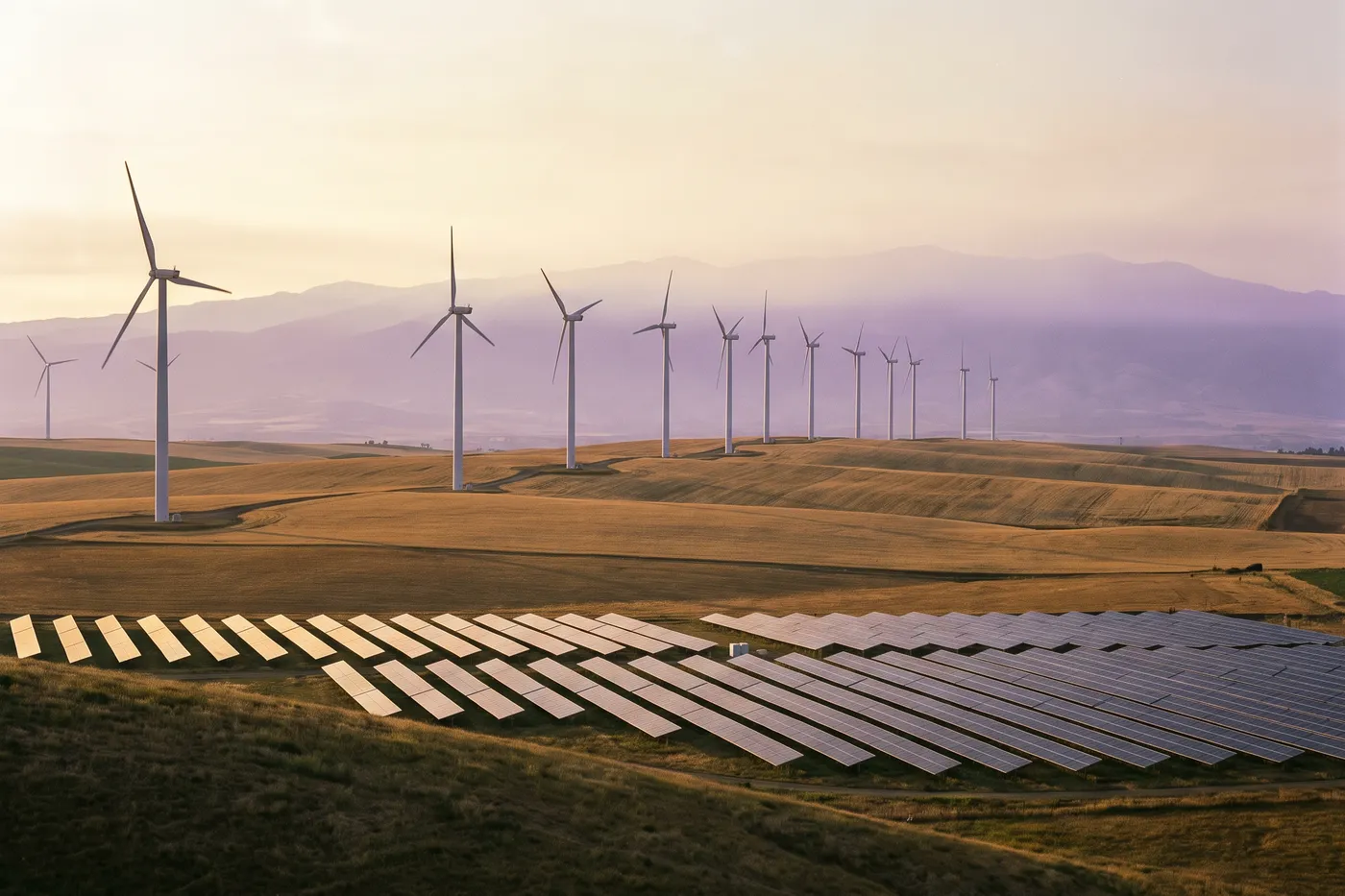
Renewable plants feed the same grid as every other plant. Developers plan a record 86 gigawatts of new capacity for 2026: 51% solar, 28% battery storage and 14% wind.[17]
Rooftop panels aren’t an option for everyone. The US Department of Energy cites an analysis finding that nearly 50% of households and businesses can’t host rooftop solar, often because they rent. Community solar lets you subscribe to a share of a nearby solar project instead, and your share earns a credit on your regular electric bill.[18]
How does electricity get to your home?
Electricity reaches your home over two kinds of wires, transmission and distribution. Each stretch of the trip shows up somewhere on your bill.
Transmission vs. distribution: what’s the difference?
Transmission is the long-distance part. It runs at very high voltage, because high voltage moves power long distances more efficiently and cheaply.[2]
Distribution is the local part, where the voltage comes down until it’s safe to use inside homes.[2] Your local utility owns and fixes the distribution lines.[13]
Follow a kilowatt-hour
From power plant to outlet
Power plant: it’s made
A generator spins, or a solar panel absorbs sunlight, and makes electricity. The likeliest source is natural gas, which made about 41% of US power in 2025.[1]
On your bill
Supply charges
Transmission: it travels far
A transformer at the plant steps the voltage up. Then extra-high-voltage lines carry the power, at 345, 500 or 765 kilovolts (kV) on AEP Ohio’s system.[3] About 5% of power is lost on the way from plant to home.[4]
On your bill
Transmission costs. Where they show up varies by utility.
Substation: the voltage comes down
A substation steps the voltage down to distribution levels, such as 34.5, 12 or 7.2 kV on AEP Ohio’s system.[3]
On your bill
Delivery charges
Meter: it’s counted
Your meter records how many kWh you use. One kWh runs a typical window air conditioner for about an hour.[12] Some apartments share a meter, so here’s how master, direct and submetering work.
On your bill
Your usage. Supply and delivery charges are both based on it.
Who runs the power grid?
No single company runs the US grid. It’s split into three big regional grids, and inside each one, grid operators, utilities and regulators share the work.
Is the US one big grid?
No, the lower 48 states run on three main grids, called interconnections. They operate mostly on their own and trade only limited amounts of power with each other.[6]
Eastern
Western
ERCOT (Texas)
Inside each interconnection, every utility runs in sync at an average of 60 hertz.[5] That’s why power flows freely within one grid but much less between them. Hawaii is separate, and each of its six main islands has its own grid.[8]
Who does what?
Power plant owners
- What they do
- Own the plants and sell the electricity they make
- When you deal with them
- Not directly
Grid operators (ISOs and RTOs)
Your local utility
- What they do
- Owns and maintains the poles, wires and meter at your home[13]
- When you deal with them
- When you start service, pay for delivery or lose power
FERC
- What they do
- Regulates interstate transmission and wholesale power sales, and sets reliability rules for the high-voltage system[10]
- When you deal with them
- Not directly
Your state utility commission
- What they do
- Regulates retail sales to you and approves your utility’s rates[10]
- When you deal with them
- When your delivery rates change
Seven grid operators serve about two-thirds of the nation’s electricity load. They’re CAISO, ERCOT, ISO New England, MISO, NYISO, PJM and SPP. In much of the Southeast, Southwest and Northwest, utilities run their own systems instead, and they often own the plants and the wires.[9]
What are supply and delivery charges on your bill?
Supply is what you pay for the electricity itself, and delivery is what you pay for the wires that bring it to you. In most of the country, one utility does both: it makes or buys the power, delivers it and bills you.
- The power itself
- The wires to your home
In 13 states and Washington, D.C., there’s statewide residential energy choice, so you can pick the company that supplies your power. In Texas’s competitive areas, choosing is required.[11] Your local utility still delivers the power, which is why the bill splits into two parts.
What it pays for
- Supply
- The electricity you use (kWh)
- Delivery
- Poles, wires, substations, meters and their upkeep
Who provides it
- Supply
- Your utility’s default service, or a supplier you choose
- Delivery
- Always your local utility
Who sets the price
- Supply
- Energy markets, or the supplier’s contract
- Delivery
- Your state regulator approves the utility’s rates[10]
Can you shop for it?
- Supply
- Yes, in states with energy choice[11]
- Delivery
- No
Who to call in an outage
- Supply
- Not your supplier
- Delivery
- Your utility[13]
In Chicago, supply is about half to two-thirds of a ComEd bill, and delivery is about a third to half. The delivery section always lists ComEd, even if another company supplies your power. The Citizens Utility Board sums it up as “supply + delivery + taxes & fees = amount due.”[12]
Why do electricity prices go up and down?
Prices usually change because generation, the biggest part of what electricity costs, gets cheaper or more expensive.[16]
- Fuel costs: natural gas makes more US power than any other source,[1] so when its price rises, electricity prices tend to rise too.[16]
- Peak demand: demand is usually highest in the afternoon and early evening, when the grid has to run more expensive plants. Prices are usually highest in summer.[16]
- Weather: heat waves and cold snaps push demand up, and droughts or calm winds can cut low-cost hydro and wind power.[16]
- The wires: building, maintaining and repairing the grid, including after storms, adds cost.[16] Your utility’s delivery rates change when regulators approve new ones.[14]
Wholesale prices change minute by minute, but most households pay a rate based on seasonal averages. The average US residential price was 17.30 cents per kWh in 2025.[16]
Some utilities charge more at peak hours and less off-peak, so people shift their use to cheaper times.[16] Our guide to getting the most out of your electricity account explains when a time-of-use plan is worth it.
What causes a power outage, and who fixes it?
Most outages are local, and your utility fixes them.[13] A storm brings down a line, a tree hits a pole, or a transformer fails.
In 2024, US homes and businesses averaged 11 hours without power, the most in 10 years. Major events like Hurricanes Beryl, Helene and Milton caused 80% of that time. In a typical year, outages outside major events add up to about two hours.[19]
Who do you call when the power goes out?
Check whether it’s only you
If the neighbors have power, check your breaker panel.
Stay away from downed lines
Keep clear of them, and report them to the utility right away.
What are rotating outages?
Rotating outages are short, controlled outages that a grid operator orders when the whole grid runs short of power.
ERCOT orders them only after asking people to save power and using emergency steps, such as bringing in power from neighboring grids. How long each one lasts depends on the local utility, the event and the weather. Smaller transmission operators aim for about 10 to 30 minutes at a time, and larger ones for 60 minutes or more.[20]
The use of load-shedding is a last-resort action for ERCOT and only occurs when all other options have been used.
How Public Grid helps
Your utility keeps the wires up, and Public Grid works on the supply side of your bill. Where there’s energy choice, we compare supply rates and look for a lower one, and we check for community solar near you. We earn money through referrals from our energy partners when we connect you to their programs.
Common questions
No. Switching suppliers changes who you buy the electricity from, not the wires it travels on. Your local utility still delivers your power, maintains the lines and handles outages. Illinois’s consumer site, for example, says there’s no disruption of service, and you keep calling your utility during outages.
Sources · 23
- 1Electricity explained: Electricity in the United States · U.S. Energy Information Administration
- 2Electricity explained: How electricity is delivered to consumers · U.S. Energy Information Administration
- 3How the System Works (poster) · AEP Ohio
- 4How much electricity is lost in electricity transmission and distribution in the United States? · U.S. Energy Information Administration
- 5Learn More About Interconnections · U.S. Department of Energy, Office of Electricity
Show all 23Show fewer
- 6U.S. electric system is made up of interconnections and balancing authorities (July 20, 2016) · U.S. Energy Information Administration, Today in Energy
- 7About ERCOT · Electric Reliability Council of Texas
- 8Energy · Hawaii Public Utilities Commission
- 9Electric Power Markets: National Overview · Federal Energy Regulatory Commission
- 10What FERC Does · Federal Energy Regulatory Commission
- 11Residential retail electric choice participation rate has leveled off since 2019 (March 15, 2023) · U.S. Energy Information Administration, Today in Energy
- 12Renting your first apartment in Chicago? Here’s how to read your utility bills (June 27, 2025) · Citizens Utility Board
- 13Switching Process · Plug In Illinois (Illinois Commerce Commission)
- 14Understanding Your Electric Bill · Public Utility Commission of Texas
- 15Transmission and Distribution Utility Rates (residential, as of October 1, 2026) · Public Utility Commission of Texas
- 16Electricity explained: Prices and factors affecting prices · U.S. Energy Information Administration
- 17New U.S. electric generating capacity expected to reach a record high in 2026 (February 20, 2026) · U.S. Energy Information Administration, Today in Energy
- 18Community Solar Basics · U.S. Department of Energy, Solar Energy Technologies Office
- 19Hurricanes in 2024 led to the most hours without power in the United States in 10 years (December 1, 2025) · U.S. Energy Information Administration, Today in Energy
- 20Trending Topics: Using load shed to address shortages in the generation supply (August 9, 2024) · Electric Reliability Council of Texas
- 21How much electricity does an American home use? · U.S. Energy Information Administration
- 22National Academy of Engineering reveals top engineering impacts of the 20th century: electrification cited as most important (March 3, 2000) · ScienceDaily (National Academy of Engineering release)
- 23REP Registration and Reporting: Questions and Answers · Public Utility Commission of Texas
